Joomla vs Drupal: business models and commercial ecosystem
I just got back from CMSExpo in Chicago where I spent a few days surrounded by Joomla people. Although the CMSExpo conference started as a Joomla-only event, it has since opened up to other Open Source content management systems including Drupal, Wordpress, Plone and more. Due to its background, however, it's still heavy on Joomla, and as a result, I had the opportunity to meet a lot of influential people in the Joomla community, including a few Joomla co-founders and members of the Joomla leadership team. I'd like to share my observations, since they are relevant for all of us in the Drupal community.
In the Drupal community, today's business-model of choice seems to be providing implementation services for medium to large websites. The Joomla community, it seems, is very focused on the low-end of the market and most people make money by selling subscription services, usually either by selling commercial support for their GPL extensions or by selling access to template clubs (i.e., a collection of templates, bundled with some level of theming support). I talked to various template club owners and was surprised by the level of sophistication and adoption -- some template clubs employ more than thirty people and have answered hundreds of thousands of support questions.
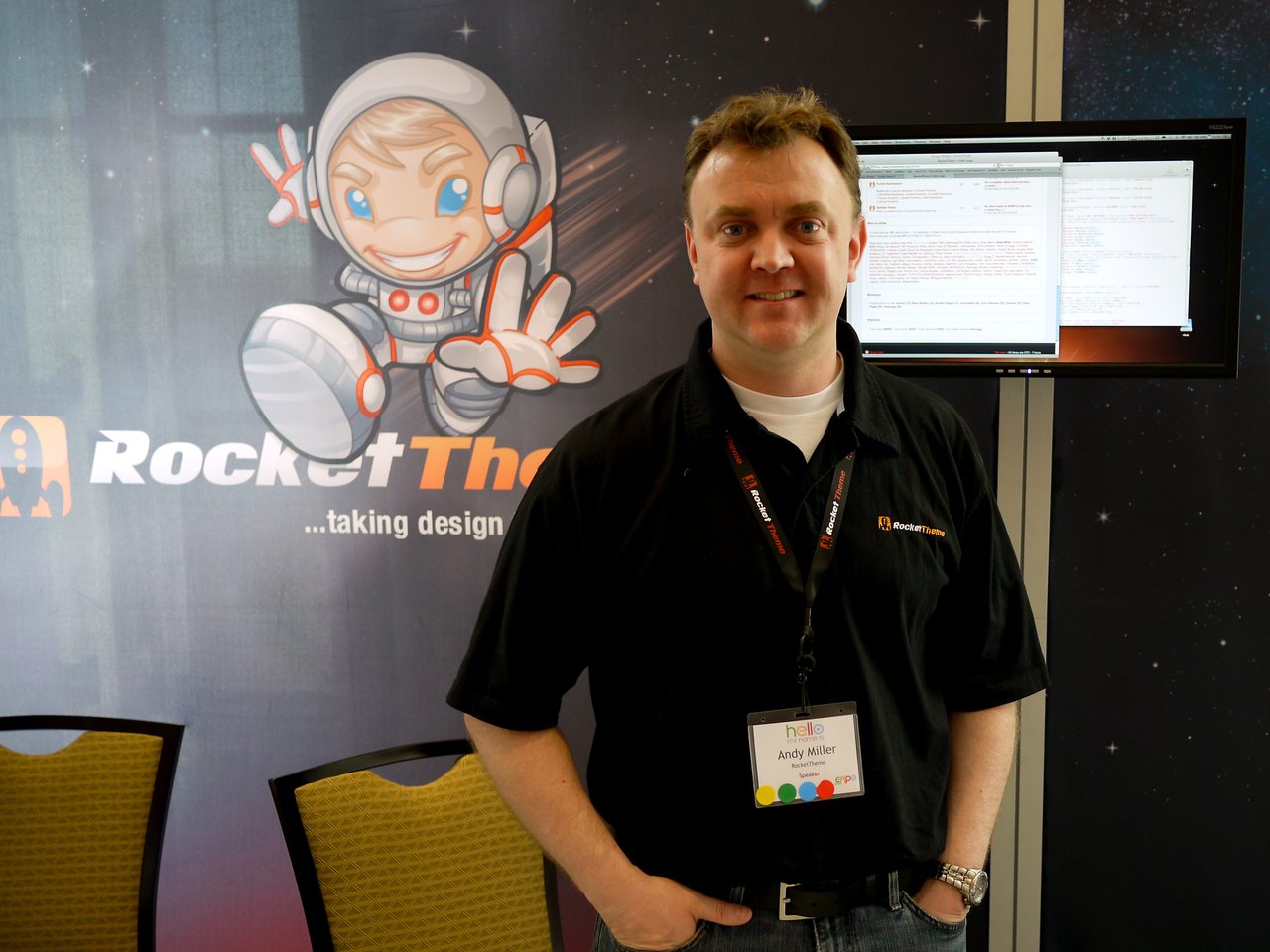
But what does the future hold? The Drupal community seems to be expanding into the enterprise, whereas the Joomla community is expanding into, well ... Drupal. All the Joomla companies that I talked to at CMSExpo were in the process of taking their products and services to the Drupal market and rebranding their organizations to be cross-CMS compatible. Andy Miller, one of the co-founders of Joomla, and CEO of RocketTheme, one of the leading Joomla template clubs, has just launched a Drupal template club. Steve Burge, the founder of a training company called Open Source Training has added Drupal training to his portfolio (they delivered 100 Joomla training classes in 2009, and plan to deliver 200 training classes in 2010). The list goes on, and all this has been going on under the radar for most of us in the Drupal community -- under mine, at least.
Andy Miller, co-founder of Joomla!, and CEO of RocketTheme. RocketTheme has about 30 employees selling templates and template support to the Joomla! and Drupal community.
Why is this happening? First, the Joomla people that I talked to believed that there was more money to be made in the Drupal world, as Drupal tends to attract larger projects. Further, the lack of Drupal template clubs is perceived as an opportunity for Joomla developers already familiar with that business model. Third, since the long awaited Joomla 1.6 release is "only" an incremental release, some people are only marginally excited about it. Contrasted with Drupal 7 and Wordpress 3.0, both of which are shaping up to be phenomenal, paradigm-shifting releases with tons of improvements and feature additions, many Joomla developers are expanding their horizons and portfolios.
All in all, this isn't a bad thing. In fact it is incredibly exciting and incredibly scary at the same time. The Joomla community expanding to Drupal could help fortify Drupal in the low-end market, which is something I want us in the Drupal community to care about a lot more. At the same time, we'll have to educate a tsunami of new community members about our values and culture to make sure that they adopt the "Drupal Way" of doing things (i.e. our culture of collaboration, sharing, passion, openness, innovation and leadership). More than ever, we'll need Drupal mentors as interesting times are ahead.
Is it really true that drupal "attracts the larger projects" or is it just that drupal is a million times better at letting the world know about those big projects.
(Another Joomla! co-founder)
May 11, 2010 - 14:36Brian - great question. Maybe you can expound and answer your own question =) After all, who better to have evidence one way or another than a Joomla! founder.
May 11, 2010 - 15:01It is a good question and I'll try to get back to you with real data on this. In the mean time, two thoughts come to mind.
First, I think Drupal has some (out-of-the-box) features and functionality that makes it a more natural choice in the enterprise (e.g. access control, custom content types, master-slave database configuration, Varnish support, MongoDB, etc). This functionality might exist in Joomla too, but maybe it hasn't reached the same level of maturity?
Second, it is not just about features. Even if Joomla and Drupal had the exact same features, I'd say Drupal's ecosystem is generally more in tune with the medium to high-end of the market. That is very important too.
It is probably the combination of both that makes Drupal attract the larger projects relative to Joomla.
May 11, 2010 - 15:57Personally after working with both, it as clear Joomla was moving away from the open source model and the ecosystem was full a hucksters trying to make a buck off their snake oil. After a few projects working with Joomla I had no choice but to leave it behind. People selling modules on subscription based licenses! How could ever recommend such ridiculous attempts at monetization to my clients? I think most anyone with the ability to reason would notice the attempts at capitalization on the Joomla community were not only counter-intuitive, but just plane gross.
That is the consensus with anyone I have talked to with experience with both, and integrity.
May 11, 2010 - 15:57I don't think Joomla was moving away from the open source model. Over 5000 extensions are listed on the JED and they are all GPL-based. The developers in the Joomla ecosystem just use a different open source business model from Drupal developers to earn money. This is because most Joomla users are small sites owners or SMBs. They could not afford to hire expensive professionals to customize solutions for them. Furthermore, most of their requirements are very in common with other small businesses. In this sense, The subscription model is most suitable for these users and developers.
July 10, 2010 - 08:45Probably a bit of both. It's a positive feedback loop, too. If Drupal gets a reputation as being *the* OS CMS for mid-to-high-to-huge sites, it will get picked up for mid-to-high-to-huge sites more often, and therefore reinforce the image of Drupal as being *the* OS CMS for that market space. That's true regardless of how good it actually is vis a vis other projects in that space.
It also means that if that is where the major Drupal contributors see their money coming from, that's what they'll develop toward and optimize Drupal for, and Drupal will become the best CMS for that market space because that's where its attention gets focused.
That's nothing unique to Drupal, of course; most products have that sort of development lifecycle.
The concern for Drupal, which Dries noted in his DrupalCon keynote and I emphatically agree with, is that the higher you go up the market the fewer clients there are. The fewer people there are. The real exciting stuff happens at the low end. The biggest threat to Drupal right now is losing sight of the low-end and not being able to play there, where the next 10 million web users will enter. It's our ability to scale down as well as up.
For that reason, I think Joomla companies from the low-to-mid range migrating over into Drupal is a great thing. It puts more "scale down" evolutionary pressure on Drupal as well, which is something we desperately need to counter balance the evolutionary pressure of Acquia, Examiner.com, Sony BMG, and other sites where "of course you've got 15 sysadmins on staff, duh" is normal. Of course, as Dries notes that requires acculturating them to Drupal and getting them involved, not just building around. As EclipseGc notes below, for instance, it would be awesome if one of these incoming theme shops could take color module by the horns and wrestle it from a nice idea into a really useful tool.
That requires helping those incoming folks understand how doing so benefits them as well as the community. That's the challenge for Drupal: acculturating more and more people faster and faster.
May 11, 2010 - 16:00I advise nonprofits and promotes open source as an ideal fit for them, and mostly recommend a CMS to them. Usually this is one of the big four, namely Drupal, Joomla, Wordpress and Plone, pretty much in that order, though that order has changed as the CMS world changed. I picked Drupal for our own site rebuild, coming to this decision via this "agnostic" fork in the road, but I have to stay agnostic as an ongoing job requirement. I just wanted to chime in and say that, until Drupal 6 or so, I think Drupal really sucked about letting the world know about anything at all that they were doing. It was all too programmer-centric. It was Joomla who were very good about letting the world know who were using their CMS, and I believe Joomla still do a better marketing job overall. Of course Wordpress is king in this regard, though for a host of factors.
May 11, 2010 - 16:58As someone who's been watching RocketTheme for a few years now, I'm happy to see them showing up on other Drupalist's radar. They have certainly placed themselves strongly in the Joomla! market and a move into Drupal's space could push us towards better color module integration, and many other cool things.
Glad to see this happening!
Eclipse
May 11, 2010 - 14:36Good news, Drupal expansion community and the new Drupal version 7.
Great post.
May 11, 2010 - 15:30I'd be a little cautious about the motives you heard for folks going into the Drupal space. I interacte very regularly with many of the folks you met at CMSX and other devs also.
Whatever the spin is, the fact of the matter is that putting all your eggs in one basket (say, Joomla) makes you venerable. Opening up to others gives not only a larger sales base, but more security if one of your fields of focus has a catastrophic shift in useability, quality, licensing, etc...
In the specifc example you mentioned, Rocketheme did Wordpress and phpBB (and even SMF) themes in the past.
Theme Forest and WooThemes have both expanded into other fields also.
May 11, 2010 - 15:49Actually, when thinking about this recently, I've made it a little mission item of mine to try and help explain "the Drupal culture" in "Come for the software, stay for the community - how Drupal improves and evolves", a session submitted for Drupalcamp Timisoara coming up early next month. I think this kind of high level overview of values, approaches, explanations of how different things (association, cons, camps, meetups, security team, core, contrib, open source, making money, etc.) fit together in the Drupal community forming the special flavour we could call the Drupal culture. I think there is a lack of such overview material, so trying to help out there :)
Session is at http://drupalcamp.ro/sessions/come-for-the-software-stay-for-the-communi... for http://drupalcamp.ro
May 11, 2010 - 16:23Hi Gabor,
I'm looking forward for your presentation at DrupalCamp in Timisoara. I'll be there. I am interested in ways of monetizing my knowledge of Drupal respecting the "Drupal way". I don't agree with selling modules, these should be always free (as opposed to Joomla, i know at least one company who makes a lot of money over selling Joomla modules - this is also fascinating in a way). Themes are okay to sell, a theme doesn't stand in the evolution of Drupal code & community.
I think Drupal will win a lot of "low-end" users if the Association could somehow encourage experienced developers to write practical knowledge-base articles (with screenshots).
When i first interacted with Drupal(Drop) (i guess it was 2001), i went "what in the God's name is a taxonomy or a node, i just want to create an article with comments attached". Only after years of programming i started loving the concept. I think Drupal community should find a friendly way to show these concepts with practical examples (screenshots + multimedia).
May 11, 2010 - 21:13Great post, Dries. I too have noticed the big difference between Joomla and Drupal being the paid modules (components/extensions). I'm sure it wasn't what was intended for the community, but it just happened. The Drupal community is great, and I think we owe a lot of it to you for setting the bar for us. I look forward to the future of Drupal!
May 11, 2010 - 17:59For now our design firm has focused almost entirely on Joomla... specializing has allowed us to be better and get more clients and keep costs low. We found wordpress too limiting and Drupal to time consuming. I too though am concerned about the future progress of all three CMS's and am excited to see what happens. Hopefully the Joomla team can get their stuff together and truly compete, because I really think it could have the most promise. Ultimately though, right now, it looks like wordpress may take over the universe. :-)
May 11, 2010 - 18:36After chatting with some of these folks at the CMS Expo, I'm also interested to see what happens. One worry of mine is that these companies seem to have an approach to theming that is very non-Drupal. Making templates in Wordpress / Joomla requires a much different approach than making a Drupal theme, but from the looks of Rocket Theme's free Drupal theme, they're using their same approach in Drupal (i.e. hardcoding forms into template files : ?). What will happen if the low-end Drupal theme market is swamped by non-Drupal themes? I think it will create confusion for new users and a false perception about what Drupal's theme layer is really all about.
At its worst, I could see themes incorporating modules and templates that don't conform to Drupal's security best practices but that exist outside of drupal.org and therefore outside of Drupal's normal channels for code / security review.
So, the theme shops will need to learn the Drupal culture but should also learn how to do Drupal theming, not just Joomla theming with the Drupal API. The problem is... re-education costs money, and theme shops charging very low prices simply might not bother.
But that's purely a pessimistic line of thinking... at its best, new people entering the market can bring fresh ideas (like the Color module example mentioned above). Let's hope as we're reaching out to them that they're also willing to reach back. : )
May 11, 2010 - 19:30Don't be so dedicated to teaching the "Drupal way" that you don't listen to suggestions for change from the newcomers that might improve the "Drupal way."
May 11, 2010 - 20:35Interesting post...and may I ask
- Can someone spell out the ecosystem as referred to "...I'd say Drupal's ecosystem is generally more in tune with the medium to high-end of the market."
- If the basic reason is that "Drupal tends to attract larger projects" which I translate to more money per client then I can't understand why rockettheme still price their membership fee for Drupal versions at the same level as for Joomla versions. Just doesn't make any business sense afa rockettheme is considered.
May 11, 2010 - 21:11Mr Dries,
I disagree with your post about Joomla! being low end. If you compare apples to apples and why you might get larger contracts. Could it be that Drupal has had Aqcuia for a long time and that Joomla! has never had a commercial company supporting the project acting a resource to the business community?
One thing I must mention is that no company in Joomla! has had 15 million dollars in capital to go out and get larger contracts. I give you credit for going out and getting the money. But you also lost control of your own company and its at the mercy of investors.
You will see the times change. Joomla! will take position in the same market as Drupal and keep the current base that it already has.
I think Aqcuia has some were around 50+ staff. When you hear that a "Template" company has 30 people on staff all from "Joomla templates" you must question the capacity we have as a project. Joomla! now has several +20 people setups. Ready to service the largest of contracts. You dont see us signing the deals but soon you will.
Template companies are going your way only because they want your money, not because anything its greener on the other side.
The Joomla! community is not running to Drupal. I think you would find the opposite if you ran the numbers.
Please dont get my wrong. I love Open Source and I think Drupal is great but its nothing like you say.
All the best with your visions.
John
May 11, 2010 - 23:21I cannot speculate on the mindset of various Joomla developers or theme developers. However, Acquia is still a relative newcomer on the Drupal scene. Drupal hasn't had Acquia for "a long time". There are lots of 10-20 person Drupal shops around that are not Acquia; the one I work for should be up to 20 people by the end of the month. :-)
Also, many of the biggest Drupal sites out there predate Acquia's existence. MTV.co.uk, NowPublic, Sony Music, etc. had nothing to do with Acquia.
Acquia has been a net positive for the Drupal community, I believe, but it's not the driving force. Don't confuse it with the company that was responsible for Mambo and that whole excitement.
Also, a 30 person theme company is great, but themers alone don't make a high-end site. It takes site engineers, designers, themers, programmers, etc. None of those alone gets you a tier-1 site. (I'm not saying the Joomla community doesn't have all of those; just that "theming" is only part of the picture, regardless of your platform.)
May 12, 2010 - 05:55I just shared my observations about the differences between the Joomla and the Drupal community. We can have different perspectives -- that is fine.
Either way, I wasn't attacking Joomla. In fact, I pointed out that Joomla does a better job in the low-end of the market. I see that is a compliment, and something that we in the Drupal community can learn from.
The Drupal ecosystem is growing up and expanding rapidly, and I'm sure that is also the case for Joomla's. I don't doubt that Joomla will become more prominent on the high-end of the market. That would be great because I think we all win when Open Source succeeds.
May 12, 2010 - 10:45Please please please please don't start encouraging a marketplace-style module emporium like what exists for Joomla - for all it results in is bad and insecure code.
Go have a look on exploit DB, and I can guarantee you, any given day, there's Joomla module exploits, really dumb crap like SQL injection on the id field and so forth. This lack of quality in code can be solely attributed to the sorts of bottom-feeder developers who are attracted to Joomla's marketplace on the off-chance that someone buys their module.
This doesn't exist with Drupal - without the financial incentive, there's no point. The only people writing Drupal modules are people who actually WANT to, and the result is a much higher calibre of code quality.
May 12, 2010 - 01:19Cameron,
That's kind of a non-starter in the Drupal world, our Licensing largely prevents such a thing.
May 12, 2010 - 08:34Cameron -
"Bottom-feeder developers?"
Not true. I am proud of our developer community and I learn from some of the brightest minds every day. For a number of years, I have also learned from some of the brightest minds here, as well.
I am a fan of Drupal and a proud flag carrying member of the Joomla! community.
Show respect, please.
Amy
May 12, 2010 - 16:02Some people might not like what you said, but you're right. And we're already started to see those things.
http://demo.rockettheme.com/drupal/d_mixxmag/?q=node/16#rokfeature
You're starting to see modules hosted out of D.o (don't blame CVS, that's not the reason). Are those modules reviewed by the Security team? No. Do they have an issue queue? No. Are they supported? Maybe. Can you ask for a new feature? Probably, but, can you jump in and help build your feature? No.
I hope Joomla themers/developers can adapt to the Drupal-way, if not, we're gonna have some huge problems.
May 12, 2010 - 17:17You are thinking way to easy and way to Drupal minded. There are lots of high quality Joomla! developers and extensions and not every extension is hosted on the extension directory. You can't convince me that everything in Drupal is that perfect, aren't there extension outside the Drupal extension directory available or aren't there Drupal sites build by programmers that are of a lesser quality and who might be writing custom extensions for clients that are risky?
Drupal and Joomla! extensions aren't iPhone apps and you better be glad they aren't :-)
May 12, 2010 - 19:22Although its good to see the Joomla community expand into Drupal I think the nature of the Drupal community (and how we do business) would make Joomla developers less interested in expanding their brand. Yes there is a market in Drupal but the degree of projects, mostly being medium and large sites, is actually what dominates majority of the work in Drupal which in most occasions requires custom code, design, and functionality.
Lets face it, before expanding a template club into Drupal one should think about the "low end" market that is heavily popular and still emerging from the Wordpress brand. There is more to Drupal than porting a theme from another CMS and have it run without problems, or concerns that many Drupal designers and developers encounter.
Interesting times are ahead and if more designers and "template clubs" jump ship this would be a great boost to themes and quality designed Drupal sites, which in turn only benefits the community.
However, implementing such a system or having others fail to understand the Drupal culture could be counter productive, it is up the Drupal community to set the bar but also embrace those willing to understand the API of the CMS.
May 12, 2010 - 07:44it is up the Drupal community to set the bar but also embrace those willing to understand the API of the CMS.
I wonder if you are understanding that these subscription clubs have already began serving the Drupal market? There are a number of others, too, and more planning the same. In a sense, I see an attitude that "they (the J! folks) have to join us and learn our ways" and I think that might be a giant jump in logic.
Don't forget to ask, why should they? And if they don't join in and contribute, then what? But most importantly, what are we seeing here? Is this a fluke of the Joomla! community impacting Drupal? Or, is this an evolving trend in our shared industry where frameworks are laid on top of frameworks in much the same manner as PDO providing abstraction needed for interaction with many databases? And, if so, what happens to the role of a CMS and how does the community continue to maintain a strong ecosystem?
May 12, 2010 - 16:57I wonder if you are understanding that these subscription clubs have already began serving the Drupal market? There are a number of others, too, and more planning the same. In a sense, I see an attitude that "they (the J! folks) have to join us and learn our ways" and I think that might be a giant jump in logic.
I don't see a jump in logic. If Joomla users want to migrate and/or contribute to Drupal they are more than welcomed to do so and that goes for Drupal users willing to venture into Joomla. But just like anything else in life; a different Content Management Systems (for this matter) has its own ecosystem and operates differently.
If one fails to adapt, or understand the other side, then one would be left in the dust. I see an attitude that "we (the J! folks) are joining a new platform, and we will do things our way."
Drupal users, developers, and designers all want Drupal to advance to its full potential and the only way to do that is expand and embrace others willing to join and contribute whichever way possible. However, we ask that all those joining the community to understand the functionality of not only the Drupal API but the Drupal community as a whole.
May 14, 2010 - 03:34I agree with this post. I have a few things to add as a person who started out in Joomla, and ended up in Drupal. To me, I believe that "the Joomla community is expanding into, well ... Drupal" is because people find that Drupal is a superior CMS. I have some points to back my opinion up. Joomla is a great CMS for starter people, but then when you start to grow, and your needs start to grow, your clients start to grow, and you need more options...more flexibility...more stability, you start to look elsewhere. Joomla just becomes a landlock. It's so hard to build a extremely flexible and robust website with Joomla. For a few quick examples; cck, permissions, users. Joomla has cck components, but they were very inflexible, and just not as awesome as Drupal's cck. Joomla's permissions is almost non existent, as well as user options. Think of it as that you can customize 99% of Drupal, while you can only customize 25% of Joomla.
Except for select many, Joomla extensions are poorly coded and broke a lot of sites. And on top of that, most of the good ones cost money. Nothing on Drupal costs money, and the modules are 100 times better coded. And the support to them is phenomenal.
Another thing that I love about Drupal, and think Joomla needs to adopt, is that modules and themes on drupal.org are extensively reviewed and screened before they are accepted. If they don't pass certain criteria, they are not accepted. This ensures: 1) quality coded extensions, and, 2) prevents duplicate extensions.
I am not here to bash Joomla at all. This is just my opinion. Joomla taught me a lot and got me excited about web design.
But, Joomla also made me hate Joomla (yes, you read that right). With every roadblock in Joomla, it angers you, and makes you look elsewhere.
I think Drupal is for everyone..big and small. It really is no harder to learn than Joomla. It just has big words like "node" and "taxonomy" instead of normal words like "articles" and categories."
Brian Teeman said:
"Is it really true that drupal "attracts the larger projects" or is it just that drupal is a million times better at letting the world know about those big projects."
--I think Drupal attracts the larger projects because anything is possible with Drupal. When you run into a roadblock with Joomla...I bet Drupal can do it. Larger projects need more features and flexibility, and Drupal can deliver; and Joomla can't.
Joomla's funding is also an issue. If you take a look at this article, you will see why:
http://community.joomla.org/blogs/community/1117-how-open-source-develop...
I do not like Joomla's open source structure. I think they are doomed to die out, and it's funding philosophy is a major reason why.
I think Dries really set himself up with Drupal's philosophy. He's got the best of both worlds; Open Source, but he's got projects to secure and promote Drupal. As well as make money from it. (Acquia, Mollom, Drupal Gardens, unique distros for the government).
May 12, 2010 - 11:51Another thing that I love about Drupal, and think Joomla needs to adopt, is that modules and themes on drupal.org are extensively reviewed and screened before they are accepted. If they don't pass certain criteria, they are not accepted. This ensures: 1) quality coded extensions, and, 2) prevents duplicate extensions.
Actually that's not entirely true. More recently, an initial module submission from a new applicant for CVS access is extensively reviewed before being accepted. Once you have a CVS account, though, the sky's the limit. Your second, third, and 14th modules are not required to be "vetted" before going live.
That was a new development intended to catch bad practices early on people's first modules without creating a maintenance burden for the CVS maintainers (who are volunteers, after all). I don't know how well it's worked since I've not been one of the people reviewing them. But Drupal modules are *not* all vetted and reviewed. There's plenty of crappy Drupal modules around. :-) Just because a module is on drupal.org don't assume it's "good".
May 12, 2010 - 16:10There is a lot said here about culture (mainly Drupal) and while there may be such a thing as a cultural difference it should never be a border in doing business but a positive challenge instead.
You can't state that Drupal is more suitable than Joomla! in high end markets because both systems are capable of doing extraordinary things when handled with the right skills, Drupal sites or extensions can be just as bad as Joomla! sites or extensions.
There is one difference at this moment that I notice, Drupal projects in many cases require more budget and people/skills than Joomla! projects and for some reason clients tend to accept that part for Drupal but expect low cost for Joomla! exceptions not included of course.
One of the reasons Joomla! is labeled as "cheap" is the huge market of template clubs and extension sales. A good example is templates, I don't know how many times I've heard a potential client say "What, that much for a custom design/template? I can get a template club subscription for way less than that" where he or she forgets a template club template is maybe "sold" a 1000 times. (Forgetting also that a custom template is about more than html/css/images namely representing his brand value in the best way possible)
The trick for Joomla! is raising the bar in quality for a fair price and the trick for Drupal is to raise/keep high quality for a fair price but develop ways to serve smaller clients with less budget.
There is one rule that applies to both or any project and business involved in using (OS) software. Don't be afraid to use the right tool for the job! There's nothing to be ashamed of for a Drupal developer to use Joomla! or WP and the other way around if the choice serves the client best.
May 12, 2010 - 12:13As Dries was kind enough mention me and our company was, figured I should respond.
Being on the Joomla board, I won't get into the pros and cons of the two, suffice it to say I'm replying to Arno as he sums up my feelings well.
The top 4 reasons we're expanding into Drupal (and other platforms):
- We like it. We've building sites and involved with our local Drupal group since 2007.
- We don't much the idea of being fanatical and aggressive about one solution being better than another. It's good that people have the choice of Drupal, Joomla, Wordpress and more and long may that continue.
- We don't want to put all our eggs in one basket as Vic mentions. OSCommerce, Simple Machines Forum, Xoops ... there's plenty of examples of projects fading away or exploding. ThemeForest, Woothemes, Rockettheme ... its part of the evolution of our industry. I suspect many of these guys will also lead the way in cross-platform frameworks.
- Acquia have made the training intentions clear. We'd actually been waiting for them to do that as they're such a big player in the industry and will inevitably shape it with their actions.
May 12, 2010 - 16:04Thank you Dries for this post and for sharing your vision. It's always kinda funny to see 'Drupees' and 'Joomlers' argue about this and that, makes me think about Anderlecht vs FC Brugge (you do remember those do you ;-) where people blabla all night long and eventually they all talk football :-)
My perception is that Drupal has been very consistent in attracting core developers, having an 'entry limit' set a bit higher compared to Joomla. This, added to 'White Houses' sites makes it look high end, granted. Reality is that the joomlasphere is so diverse that communication has never been centralized, so when a big company uses Joomla, the Joomla Project itself knows about it a year later or... never. There are plenty examples of very big companies and organisations using Joomla, just we don't know about them, so the big picture is lost somehow.
Anyway, as a fellow Belgian I can only admire what you've achieved with all the Drupal community and wish you and Drupal all the best!
Marcos
May 12, 2010 - 14:28/me Joomla fan in case you haven't noticed ;)
In my opinion, the major reasons why most of the people consider Drupal being strong in the high-price orders and why Joomla! is not are some of the following:
- I have never seen a corporate project from Joomla! core developer announced somewhere. They simply don't do it. Instead, all major sites where Dries is involved get a lot of publicity. So high-price orders exist in Joomla!, but these are not that much announced.
- We keep hear about Sony, MTV etc., but people usually forgot Porsche, Schneider Electric, MTV as well, now Tesco and many more.
- Building one big site is definitely a very popular way to make PR. But I am aware of orders for million of EUR, which simply includes building of many projects with Joomla! for a single company.
May 12, 2010 - 14:55There is one reason I'm not longer using Joomla and I started to love Drupal. All in one place, great software, great community, great docs, great API. You don't find any of those things in Joomla. But the minute I have to pay to use Views or Panels, I'm out and Drupal will start to die slowly.
May 12, 2010 - 16:47I am new to the Drupal Community as a Web Site Manager (well, any CMS community really), and also just returned from the CMSExpo in Chicago. The big difference that I saw between the various CMS types was some very basic "high-end" marketing strategies. Drupal lags behind in high-end marketing sophistication, and is NOT overly "understandable" to those "non-developer" decision-makers.
The Drupal.com website is a poorly designed site and when a top-notch marketing group members investigates this option of using Drupal, it becomes a HARD sell to go with Drupal, instead of another CMS (because they all "looked" so good.) It took much convincing to look beyond the "skin" and marketing materials of a cms, and understand its usefulness and flexiblity, you know, the inside of a person (or cms!)
Maybe as you roll in more managers and designers into the Drupal community itself, others will follow, without needing the biggest sell job to the internal web team making the final decisions of which direction their web site should go. I wonder out-loud if Drupal seems to net the "high-end" web sites, because those are the web sites with technical developers involved in the decision-making -- all others are scared away by the angry water droplet guy!
And, with all that said, I am SO glad our external developer talked pitched Drupal for our re-design - it is indeed a very exciting community ;) and we are extremely happy with our site's outcome!
May 12, 2010 - 19:02I don't think you should aim for low end. Drupal atracted me like Linux attracted me by saying this is very quality code and you will be able to learn and play with it. No its not gonna be easy but its gonna be quality AND you will be away from the bad people writing bad software and trying cheap scams. I was a mambo user , the a Joomla user but soon I was looking for something else. Bad corporation trying to make a quick buck will sink you faster then you think. Drupal has a good rep BECAUSE it draw good people.
May 12, 2010 - 22:37If what your saying about Drupal serving the larger corporate market is correct..then it is also likely that successful developers serving this market and corporate employees are much more secure in their income stream either through employment or long term service contracts.
Snotty remarks about some Joomla module developers charging for their extensions.... sounds to me like white collar workers looking down their noses at those disgusting entreprenuerial insects....Anyone old enough to remember IBM and Microsoft.
If you make a million a year and donate $50 (which your tax accountant probably deducts $100 for compared to someone who makes 20,000 and gives $25... only your snobbery allows you the ability to somehow think your superior.
If one takes a moment and does a little research , the amount and variety of free extensions on the JED blows Drupal away. True they maybe small donations of code compared to the chunks your corporate guys give, but thats no reason to put on airs and graces.
This is not meant as a diatribe against the Drupal community, just like you - we have our own zealots who feel the need to put down everyone else to justify their own choices.
May 13, 2010 - 00:13Long may we both live and prosper.
If you join a community you are treated as a guest. People will welcome and respect you and help you get started until you are part of the community.
In Drupal community everyone is welcome and it usually doesn’t take a long time until someone feels like she/he is part of the community.
However if you are new and you come like a punk and break the rules people will at best ignore you. I am not saying this is the case but things like selling modules or hosting modules elsewhere is a direct attack to the way we work and therefore to Drupals success.
Doesn't mean everything’s perfect here and there is nothing new to learn for us, in fact I had a long talk to a former Typo3 guy at www.drupal-dev-days.de last weekend what we could learn from Typo3 but we also agreed (me coming from Joomla a few years ago) that the way the community works together in Drupal is pretty awesome.
Btw: There are quite a few high profile companies using Drupal with sites that are not know. In fact Joomla was way better in marketing in the past but maybe that is about to change.
May 14, 2010 - 15:24I tend to agree with Jo's comments that some of these responses about Joomla! folks are highly offensive and very snotty. And, I am well known to be a big Drupal fan.
Let's be clear that developers who sell subscriptions for support services and manage distributions behind gated communities are well within the terms of the GPL.
What Dries is raising are some very interesting points and asking how to bring these new constituent groups into the fold. I see a lot of assumptions that this will automatically happen and that those new people will have to change or there will be a price to pay!
Probably not the best approach for gaining involvement and this attitude is no doubt turning people off already.
You need to understand that these businesses don't actually need community involvement. What they are doing is building a layer, or interface, that interacts with different CMS's. With that in place, the work to build a theme or module, can be done once, and used in different environments. They are smart business people expanding their market at little cost to cross our traditional community boundaries. This trend is taking hold, not just in Joomla!, but across the board.
I admire the Drupal community because it is an excellent example of a cooperative, collaborative and open-minded group. I see members supporting one another and finding ways to adapt to different thinking. If you continue doing that, your inclusive and open attitude will encourage involvement and people will find a way to contribute something back.
But, if you greet people at the door with a "You must comply" and "We are better than you" attitude, human nature will step in.
Anyway, good post, as usual, Dries. Three years ago (or four?), at the OSCMS conference, you called for a goal to improve Drupal until developers were not needed. Congratulations - this is a sign you are starting to reach that goal. We need another OSCMS conference - things are converging and we should be looking at that, just as your post suggests.
One more point, Andy's work at RocketTheme is very high quality. You guys are going to love having his work available for your community. The one thing to watch out for with Andy is that he cheats at putt-putt golf. So, consider yourself warned. ;-)
May 13, 2010 - 14:37I gave Drupal a shot a couple years ago, but discovered I could meet my goals faster and more easily with Joomla.
Of course, any project's goals will determine what tool works best after rigorous testing.
What I find interesting is the commentary on low-end vs high-end projects and which niche Joomla and Drupal have covered, respectively.
For years, Drupal has been notoriously more difficult to theme than either Joomla or Wordpress. This initially lead to the development of more Joomla theme clubs.
As these clubs grew and evolved, the quality of their products improved by leaps and bounds, while the costs per template continue to drop as each company's inventory expanded.
This made it cheap and easy for someone to install joomla on a shared host, buy a *great* template for a low price, and get an awesome-looking website setup in no-time.
Meanwhile, Drupal developers courted high-paying contracts, the community maintained rigors coding standards and kept up a high barrier of entry, all of which contributed to a perception that Drupal is the "developers choice" it serves high-end markets better, and is the most capable of the big three.
In addition, one must keep in mind that business want one thing in the end - good looking and well functioning websites. Now, because Drupal has had a dearth of template development companies, most Drupal projects begin with a high operating cost because the *design* has to be developed from scratch, every time, if the customer is to get a decent-looking website. There just haven't been any low-cost, satisfactory, canned solutions.
Until now.
What Rockettheme.com is doing (and other developers like Joomlart.com) is turning this high-cost-of-entry paradigm on its head.
If businesses can see that cheap, good-looking templates exist for Drupal, they will be reluctant to pay big bucks to get what they want - a little customization will satisfy them for a fraction of the 100%-custom design solution.
This may have the effect of eliminating the common misconception that Drupal is only for high-end projects or that those projects need to command high rates.
Beyond templates, though, there is something more fundamental here which Drupalistas need to understand about Joomla development.
Architecture:
Joomla 1.5.x and the new version of Joomla (1.6.x) operate on an object-oriented, model-view-controller architecture which runs on top of an immensely power framework/API.
Joomla *can* have a diverse community of developers functioning in loosely knit networks.
1. Someone who has taught him/herself to develop for Joomla already knows the *exact* structure and rules which need to be followed to create extensions which properly integrate with the core and can communicate with other extensions should the need arise (more on this later).
2. The logical breakdown of CMS extensions defines a solid, clearly-understood, construct of how all the CMS elements work together:
-plugins: act on website data input/output at various stages of page generation, from login to final html output.
-module: contained blocks of code which process and output data to a variety of template-defined fields throughout a website. They can be placed in any given position, on any given page, while meeting a wide variety of conditions.
-component: a self-content group of code which operates as a web-application installed on the CMS itself. It interacts with (and is acted upon by) modules and plugins.
To sum it up, the Joomla framework, API, and development architecture work together to represent what I see as the most powerful and thoughfully laid out tools set for out-of-the box web application development.
The raw materials - PHP, Apache, MySQL, javascript - are all there in Wordpress, Joomla and Drupal.
What Joomla has been able to do though, in a way not seen in Drupal or Wordpress - is true democratize the development *process* and create at fully-realized and sustainable structure in which to build one's ideas in a way the is universally compatible, instantly connecting the work of all developers.
In a way, Drupal and Joomla are very similar. Both require strict adherence to coding standards in order to achieve satisfactory results.
Where they differ is in how they educate developers in exercising that discipline:
Drupal ensures code quality through it's close-knit, developer ecosystem by providing high barriers of entry and guarding all extensions closely.
Joomla ensures code quality through the very structure it incorporates within the core of it's coding and providing easy access to information so developers can teach themselves the rules first.
May 13, 2010 - 21:31We can sit here and argue about the good & the bad about either of them, but as a web developer, I prefer "the Drupal way".
May 14, 2010 - 07:57Good post Annatech.
You answered “Except for select many, Joomla extensions are poorly coded and broke a lot of sites.”
Bcs this is not true at all - just a lie.
I am just an normal Joomla user for 4 years Drupal 2 years and can’t be familiar with what some people say here about Joomla. Joomla model have been discuss over the years and working well in the "Joomla way".
I know that Drupal have nodes, taxonomies, vocabularies, terms and hierarchies unlimited subcategories that Joomla don’t have in the core but as extra extensions. But what else is superior with Drupal 6 core compared to Joomla 1.5 core than the node structure? Both frameworks are very flexible in my opinion and have their pro and cons.
What I don’t like is the general talk and opinions like “Drupal is flexible but Joomla is not its just for the low-end and you cant use Joomla for high traffic web sites, Drupal have quality code and Joomla have not, Drupal is secure and Joomla is not,
Both Joomla and Drupal is great CMS configuration systems with a lot of flexibility to integrate and build whatever web site you want but I think we must have more facts about "our opinions".
I think both would gain a lot of they also focus on better integration with other great open source systems and using Jitter, Talend, OpenBravo, SugarCRM, Compiere, SpagoBI etc for really getting into the commercial landscape. Also Microsoft has now open up and started supporting Joomla.
But what I think is also that Joomla legal structure is better than for the Drupal community long term and don’t understand the comments post here about Joomla's funding should also being an “issue”.
I don’t understand?
“I do not like Joomla's open source structure. I think they are doomed to die out, and it's funding philosophy is a major reason why.” http://community.joomla.org/blogs/community/1117-how-open-source-develop...
For me that’s one of Joomlas strengths against Drupal that make me choose Joomla! The better total legal structure of a CMS open source project!
There you also see that Joomla have an other vision and importance of how community ownership is govern not just about the code GPL and the “Ownership of Brand Assets” like trademarks etc and that this is guarantee to the whole Joomla community by a non profit organization “Open Source Matters” and not to an individual.
I think there is a also lot of Drupal developer in countries/regions like USA, UK etc where the “real” world is isn’t it? But how is it in the rest of the world? http://www.google.com/trends?q=drupal%2Cjoomla&ctab=0&geo=all&date=all&s...
And Joomla have large sites and projects too that use Joomla framework from different type of usage and type of clients from building Twitter smart marketing applications http://my.peoplebrowsr.com/ to large news site.
Examples:
Gazetta sport news web site with more that 5 million visitors per month. http://www.gazzetta.gr/ with a lot of authors, ACL, CCK etc
United Nations
http://www.coolplanet2009.org/
Multisites one example of Australia’s largest regional TV network
http://www.jentla.com/software/multisite-challenge.html
http://www.jentla.com/software.html
http://www.jentla.com/solutions/media.html
Example again: “For a few quick examples; cck, permissions, users. Joomla has cck components, but they were very inflexible, and just not as awesome as Drupal's cck.”
Joomla have many CCKs like Nooku framework, K2, FLEXIcontent, Zoo, Jseblod CCK etc and it’s a question for Joomla if a cck should be in the core or not. I believe a CCK should be but we will see how the decision will be for the future. Joomla official extension directory have more than 4855 extra addons to put into Joomla and a lot also outside that not comply with the GPL rules to be on JED.
And you have examples like free GPL Joomla Jseblod CCK that you would call bad quality Joomla coders??
http://www.jseblod-cck.com/news/3828-jseblod-cck-stable-16.html
http://extensions.joomla.org/extensions/news-production/content-construc...
Where you can build complex anything from Real Estate sites http://www.osimmo.fr/ to what ever?
With Joomla you can set up an advanced Joomla integrated forum like phpBB in 10 minutes with integrators like Jfusion. So it all up to how much or little should be in the core or not? And that’s a balance for every CMS to decide.
Its not hard to build a complex web site with Joomla – on the contratry compared to Drupal but as with both CMS you must have knowledge and skills for it.
This comparison http://www.cmswire.com/cms/web-cms/sxsw-web-content-management-system-sh... showed how easy it was to build web sites for Drupal, Joomla and Wordpress.
How the Teams Compare Drupal, Joomla and Wordpress
Here is a comparison of how the sites came together under deadline:
Drupal Joomla! WordPress
Total Hours 79.25 57.25 90.5
Hours spent on front end 21.75 15 36.5
HTML Validation No (8 errors) Yes No (8 errors)
CSS Validation No (7 errors) No (1 error) No (21 errors)
Page weight 180K 140K 154K
Lines of custom PHP/JS code 220 30 1,808
Or here you can see how other judge Drupal, Wordpress and Joomla not only from your own community and forum.
http://php.opensourcecms.com/scripts/show.php?catid=1&cat=CMS%20/%20Portals
And the Joomla community is also like Drupal very active and friendly http://people.joomla.org/
I and many would appreciate urls of those many high traffic complex Drupal sites bcs thats important to know and verify facts before you start buzzing about things that may not be true or not isn’t it?
If you want to test Joomla and how it works you can make a test drive here:) http://demo.joomla.org/
Thanks for sharing and building open source and open minds !
ssnobben
May 14, 2010 - 10:39"I and many would appreciate urls of those many high traffic complex Drupal sites bcs thats important to know and verify facts before you start buzzing about things that may not be true or not isn’t it?" Just look at the sites presented at this blog. http://buytaert.net/tag/drupal-sites
You can find more at the frontpage posts on drupal.org but most medium-sized Drupal sites like schweizer-illustrierte.ch don't find their way there as well.
jentla. That's like Joomla on steroids?
May 14, 2010 - 19:04This exactly the thing I am talking about. The thing I don't want for Drupal. In "Drupal universe" what comes closest to this are install profiles. Bundles of Drupal modules and configuration that meet specific needs like OpenAtrium or Acquia Drupal. (More here http://drupal.org/project/installation+profiles ) But they are all (afaik) free and open source. If some of the development happens outside of drupal.org this is not a problem as long as most of it comes back at some time.
Joomla is widely used in The Netherlands.
Examples:
www.nutreco.com
Nutreco employs almost 9,300 people in 30 countries, with sales in 80 countries. Headquartered in the Netherlands, Nutreco is listed on the Euronext stock exchange in Amsterdam and has annual revenues approaching EUR 5 billion.
www.fondsnieuws.nl
Part of the biggest financial daily in Holland.
May 15, 2010 - 11:57I just came across this post by Dries. I, too, was at the CMS Expo, and I wrote up some impressions, in particular touching on Drupal/Joomla comparisions. You can read my writeup here:
http://prototaph.com/index.php/Protoblog/Events/what-i-learned-at-cms-ex...
Dries hits the nail on the head when considering how different open source CMSs may have more or less appeal for specific markets.
June 17, 2010 - 21:47I am a very, very junior developer in Drupal when compared to all the gems who have posted above. However, I would like to share my experience of how I entered the world of Drupal and have been living here happily ever since:
This was back in 2005 or 2006 I guess. A colleague of mine and I were given the task by our boss to identify the best CMS out there to build a community portal for a social cause. He came up with Joomla and I stumbled upon Drupal. At that time, we did not find any expert blogs or documents with a comparative analysis. So, we decided that we will simultaneously develop the same concept in both the CMS and show to our boss. I was already in love with Drupal by then, having installed it for the first time.
Eventually, when the day of judgement arrived he had a far better looking website than what I could render with my amateur CSS, PHP, and Drupal skills. However, inside my heart I had the conviction that it was my lack of knowledge and not Drupal's limitations that put me one step behind. Then, I developed some custom features in Drupal using its flexible hook system which was, of course, difficult to reproduce in Joomla without advanced PHP knowledge. I convinced my boss that Drupal has better scalability for "development" and that Joomla is more for "webmasters". My colleague got offended and we broke into a cold war, which led into his quitting the company after some time. However, my love for Drupal kept on increasing and now I am working as a full-time drupal consultant (my academic background is masters in psychology)...
So, in simple terms Drupal rocks because it allows the developer to create something that is in his mind limitlessly rather than use what is out there to fulfill the needs. Again, this is totally my personal opinion and may not carry any technical weightage.
Kudos to Drupal ! Thanks to Dries :-)
July 13, 2010 - 17:31I personally would be cautious about the way the "Drupal Way" is talked about in some of these comments. In the same way people religiously prefer open source to proprietary I think people are doing the same here.
I think there is a clear reason why you'd want a "Drupal Way" module. The fact is by being truly open source many people can help make that module better, and if it is a successful module you can have security knowing its likely to be around for a while. If merlinofchaos disappeared other people could take over and continue work on views because Drupal needs it. But the scary thing with any paid-for component with Joomla is that you're always at the developers mercy. The same is with simple bug fixes and security patches. You can just do it yourself and have someone check it over before committing it knowing that its going to be in the software for future updates.
The way I see it, Drupal is fully open source whereas Joomla encourages a proprietary market on top of an open source framework. They have the same kind of disadvantages and advantages as Microsoft vs Linux. For this reason I love some aspects of how Joomla works (You can make commercial sites so quickly and because you have paid are more entitled to support). On Drupal you need to learn the ropes and have to be polite before you get anywhere. This is cool but sometimes you just need speed.
July 22, 2010 - 13:40Very high quality Post and a broad of good people comments.
I'm glad to find this post which don't degenerate as usual in a Joomla/Drupal war ...
There is an inexorable motion there; we like it, we don't like it, but it's happening.
In a way, Joomla becomes Drupalized and Drupal becomes Joomlaized like 2 galaxies who dance around each other inexorably closer and closer...attracted by their own gravity.
- With Joomla 1.6 will come (at last...) a robust core ACL with Groups management and open categories structure...Those are natives with Drupal since ages... (and are in my limited experience the main reason to chose Drupal over Joomla as framework to build on for many projects.)
- With Drupal 1.7 will come (at last...) a bunch of user-friendly or accessibility oriented modification and update.
- With the expansion of Joomla companies (RocketTheme for example) in the Drupal territories, a new world is emerging and as said by Dries in the initial post : it's exciting and scary in the same time.
Those guys at RocketTheme have made a terrific jobs, their templates have a level of customisation that impressed me many times and theirs components/modules are incredibly useful.
As a Drupal fan you can't miss this opportunity to focus your skills on what really matters : the clients specs, personalized modules, what's under the hood literally ;-) and to reduce drastically your project time. (Yeah yeah i know it sounds like the commercial guy, brrrrr.)
As always change is not welcome by some, applauded by others; how can we keep the things we care the most to continue to exists in a new world? in a new form? Are all things really important to kept? to fight for?
At the end, both Joomla and Drupal can do marvel in the right hands if chosen for the right project, that's a fact.
What does the future hold ? who knows... but one thing is sure: open source community win with those 2 powerful framework.
Maybe in few years, we could witness ten of thousands of people who exchange merrily their Joomla/Drupal t-shirts in a big kind of "Woodstock-CMS-linux-expo" to annouce the new DrupJoom, JoomDrup, JoDrumal, DruJomal...whatever... with a flood of good music and beers... Ô mama...
Exciting and scary times, definitively ;-)
July 26, 2010 - 11:35Post new comment